A brake master cylinder is one of the most important parts of any braking system. Every time the brake pedal is pressed, this component is responsible for turning that movement into hydraulic force that actually slows the car down. Without it, there is no way to transfer input from the driver into usable braking pressure.
Different setups use different types and sizes of master cylinders. Getting this right has a direct impact on pedal feel, response, and how the car behaves under braking. That becomes even more important in performance and motorsport environments where consistency and control matter just as much as stopping power.
What Is a Brake Master Cylinder?
A brake master cylinder sits at the start of the braking system. It is connected directly to the brake pedal and works as the main control point for hydraulic pressure.
Inside the unit, pistons move through brake fluid when the pedal is pressed. That movement creates pressure in the system, which is then sent through the brake lines to the calipers at each wheel.
Every braking system relies on this process. No matter how advanced the setup is, it still depends on the master cylinder to generate pressure in a controlled and repeatable way.
What Does A Brake Master Cylinder Do?
The role of a brake master cylinder is to convert mechanical input into hydraulic pressure. When the driver presses the brake pedal, that force needs to be transferred through the system in a way that can apply consistent braking at all four corners.
The master cylinder handles this by pushing brake fluid through the system under pressure. That pressure travels through the brake lines and reaches the brake calipers, where it forces the brake pads against the discs.
Consistency is key. If pressure builds unevenly or drops under load, braking performance suffers. A properly matched master cylinder helps maintain a stable pedal and predictable response, which is especially important during repeated heavy braking on track.
How Does A Brake Master Cylinder Work?
The process is straightforward, but it needs to work perfectly every time:
- The driver presses the brake pedal
- A pushrod transfers that movement into the master cylinder
- The internal piston moves forward
- Brake fluid is pressurised inside the cylinder
- Hydraulic pressure travels through the brake lines
- The brake calipers apply force to the discs
Everything happens in a fraction of a second. The system relies on brake fluid being incompressible, which allows pressure to transfer instantly from pedal to caliper.
What Are The Different Types Of Brake Master Cylinders?
Remote Master Cylinders
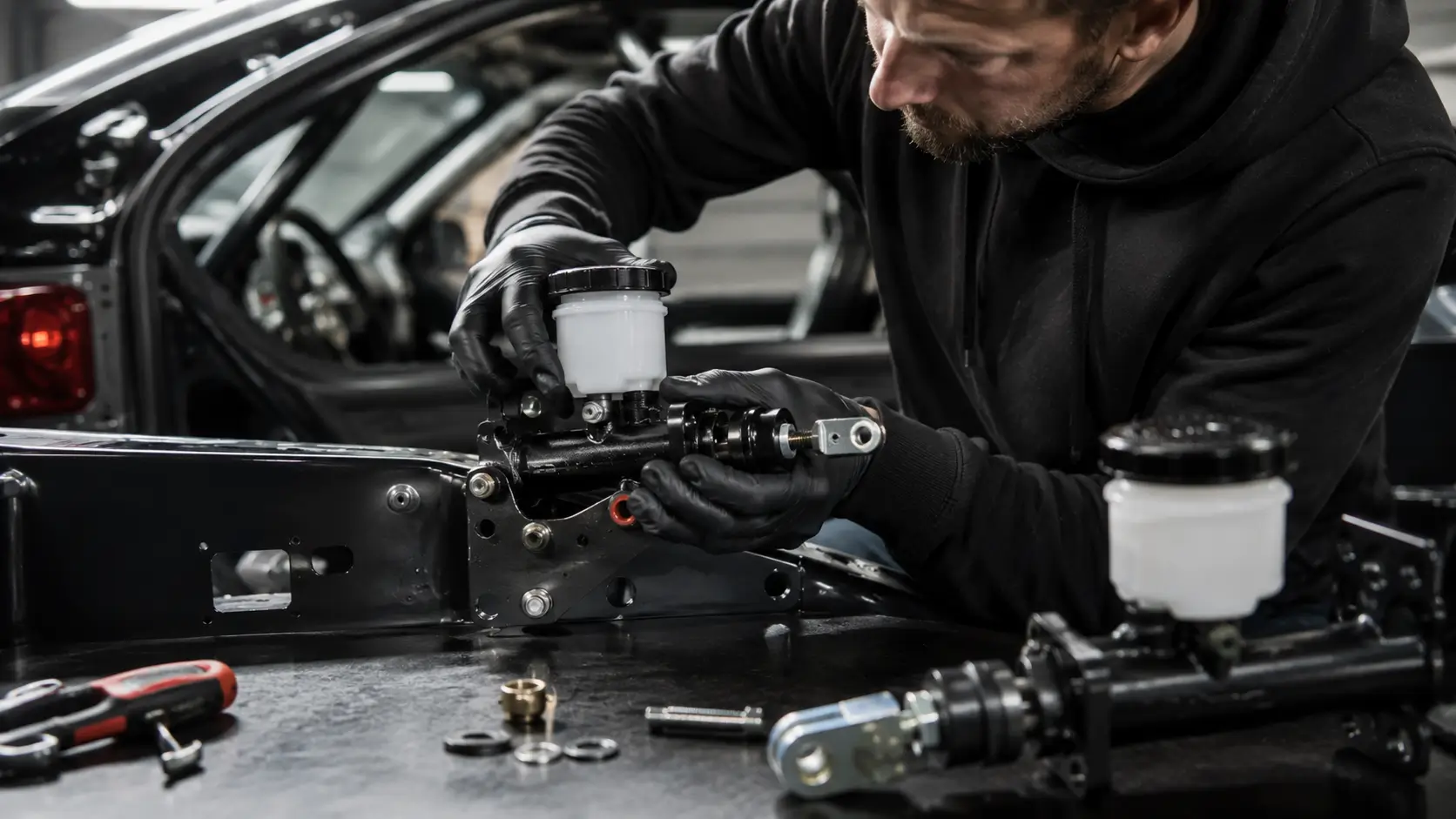
Remote master cylinders use an external reservoir connected by a hose. This setup is common in motorsport and custom builds where space is limited or where access for maintenance needs to be easier.
They are often used alongside pedal boxes and can be positioned more flexibly within the engine bay or cabin.
Integral Master Cylinders
Integral master cylinders have a built-in reservoir. Everything is contained within a single unit, which makes them more compact and straightforward to install.
These are commonly used where simplicity and packaging are priorities, particularly in more standardised builds.
Dual Master Cylinder Setups
Dual setups are typically used with pedal boxes and allow separate control of front and rear braking circuits. This makes it possible to adjust brake bias, which is a key part of performance tuning.
Each master cylinder controls part of the system, giving more control over how braking force is distributed.
Why Does Master Cylinder Bore Size Matter?
Bore size refers to the internal diameter of the master cylinder. This has a direct effect on how the brake pedal feels and how pressure is generated.
A larger bore moves more fluid with less pedal travel, which can result in a firmer pedal. A smaller bore increases pedal travel but can provide more sensitivity and control.
The correct choice depends on the full braking setup. Caliper size, piston area, pedal ratio, and intended use all play a role.
Getting the balance right is important. Too large and the pedal can feel harsh with less control. Too small and the pedal may feel long or inconsistent under load.
| Bore Size Direction |
Typical Feel |
Setup Consideration |
| Larger bore |
A firmer pedal with less pedal travel |
Can feel harsh with less control if too large |
| Smaller bore |
More pedal travel with more sensitivity |
May feel long or inconsistent under load if too small |
How To Choose The Right Brake Master Cylinder
Choosing the right master cylinder depends on how the car is used and how the braking system is set up.
For track and motorsport builds, the focus is usually on consistency, pedal feel, and the ability to fine tune braking balance. Road setups may prioritise ease of use and compatibility with existing components.
Pedal box compatibility is another key factor. Many performance builds use a pedal box setup, which changes how master cylinders are mounted and operated.
Space and packaging also matter. Some builds require remote reservoirs due to limited room, while others can use integral designs.
Supporting hardware should always be considered. Calipers, discs, brake lines and fluid all contribute to how the system performs. The master cylinder needs to match the rest of the setup.
Track and motorsport use
For track and motorsport builds, the focus is usually on consistency, pedal feel, and the ability to fine tune braking balance.
Pedal box compatibility
Pedal box compatibility is another key factor. Many performance builds use a pedal box setup, which changes how master cylinders are mounted and operated.
Space and packaging
Space and packaging also matter. Some builds require remote reservoirs due to limited room, while others can use integral designs.
Supporting hardware
Supporting hardware should always be considered. Calipers, discs, brake lines and fluid all contribute to how the system performs. The master cylinder needs to match the rest of the setup.
Brake Master Cylinders & Pedal Boxes: What Is The Connection?
In many performance builds, the master cylinder is part of a wider control system that includes a pedal box.
Pedal boxes allow more precise control over braking inputs and often use dual master cylinder setups to adjust front to rear balance. This is especially useful in motorsport where conditions change and braking needs to be fine tuned.
Hydraulic handbrakes are also part of this system in many builds, particularly for drift or rally applications. These rely on the same hydraulic principles and often integrate with the braking setup.
Brake Master Cylinders FAQs
What is a brake master cylinder?
It is the component that converts brake pedal movement into hydraulic pressure within the braking system.
What does a brake master cylinder do?
It generates and controls the hydraulic pressure that allows the brakes to work.
How does a brake master cylinder work?
It uses piston movement to pressurise brake fluid, which is then sent through the system to apply braking force.
What size brake master cylinder do I need?
The correct size depends on your full braking setup, including calipers, pedal ratio and intended use.
What is the difference between remote and integral master cylinders?
Remote versions use an external reservoir, while integral versions have the reservoir built into the unit.
What is a dual master cylinder setup?
It uses two master cylinders to control separate brake circuits, often allowing brake bias adjustment.
Find The Right Brake Master Cylinder For Your Setup
A brake master cylinder plays a central role in how a car feels under braking. Whether the goal is improved control on track or building a complete motorsport setup, choosing the right components makes a noticeable difference.
Compbrake offers a full range of master cylinders, pedal box master cylinders, and supporting components designed for performance applications.
If you are planning a build or upgrading your braking system, the right advice can help you get the best result from your setup.
To speak to our team, you can call us on 01744 895888 or fill in our online contact form.






![0.551 AP Racing Remote Master Cylinder [Black & Orange Label]](data:image/svg+xml,%3Csvg%20xmlns='http://www.w3.org/2000/svg'%20viewBox='0%200%200%200'%3E%3C/svg%3E)
![0.551 AP Racing Remote Master Cylinder [Black & Orange Label]](https://compbrake.com/wp-content/uploads/2022/01/MASTER-CYLINDER-AP-X1-300x300.jpg)